Systems Don't Fail From Load. They Fail When They Change State
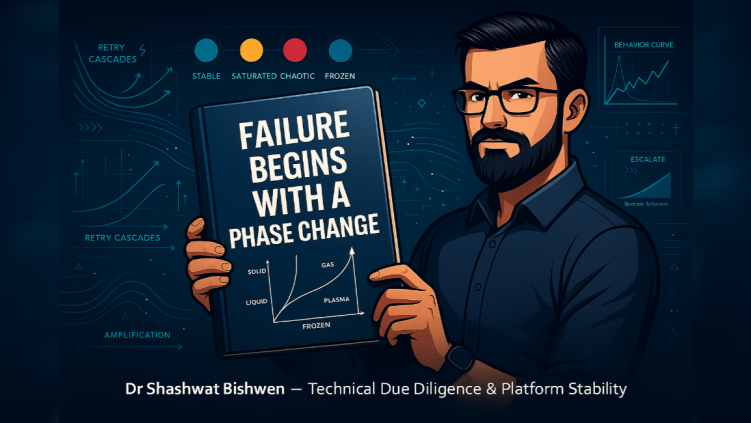
Most platforms do not collapse because of high traffic volume. They collapse when a transition threshold changes behavior: a cache eviction cascade, a connection pool saturation, or an unindexed failover state shift.
When a major production system collapses during a marketing flash sale or high-traffic event, the post-incident summary almost always cites the same excuse: 'Unprecedented traffic volume overwhelmed our servers.'
This explanation is almost always false.
Systems rarely collapse purely from linear request load. High load merely pushes the system toward its operational boundary. What actually causes catastrophic failure is a sudden, non-linear State Change.
Consider a familiar pattern: A service handles 50,000 requests per second comfortably because 98% of queries hit an in-memory Redis cache. Suddenly, a minor network jitter or memory eviction causes cache hit rates to drop from 98% to 92%.
That small 6% variance changes the state of the system entirely. Backend database read traffic instantly increases by 400%. The database thread pool saturates, connection timeouts back up into HTTP gateways, and the entire platform locks into a death spiral.
The system did not fail because of traffic; it failed because its operational state shifted from cached equilibrium to database starvation.
Resilient engineering requires identifying every hidden state transition boundary and enforcing hard circuit breakers before the tipping point is crossed.
Continue the Thread
Solution Assembler, Systems Advisor, TEDx Speaker, and Author. For 24+ years quietly stabilizing platforms, eliminating operational drag, and making broken systems predictable.